How Many Liters of Water Should I Drink Per Day? A Personalized Calculation Guide
Calculate your exact daily water needs based on weight, activity, and climate. Move beyond the '8 glasses' rule with science-backed hydration targets.

How Many Liters of Water Should I Drink Per Day? A Personalized Calculation Guide
Why Personalizing Your Hydration is Essential
- ✦Avoid over-hydration and electrolyte imbalance.
- ✦Maintain peak mental focus and cognitive performance.
- ✦Optimize physical endurance and recovery times.
- ✦Adjust naturally to changes in weather and humidity.
- ✦Understand exactly how much moisture comes from your food.
- ✦Build a sustainable habit without the pressure of arbitrary goals.
What Does the Science Actually Say?
The NASEM Benchmarks
The 20% Food Rule
Personal Factors Matter
The Diuretic Myth
How to Calculate Your Ideal Daily Water Intake
1. Apply the Weight-Based Formula
- Find your weight in kilograms (kg).
- Multiply that number by 35 (ml).
- The result is your daily baseline in milliliters.
- Example: 70 kg × 35 mL/kg = 2,450 mL (approximately 2.45 L).

2. Adjust for Physical Activity
- Calculate your workout duration.
- Add roughly 400–800 ml for every hour of moderate effort.
- Drink before, during, and after your session.
- Check for sudden weight loss post-workout to gauge fluid loss.

3. Factor in Your Environment
- Monitor local humidity and temperature levels.
- Increase intake by 10-20% on extremely hot days.
- Extra hydration is needed when traveling to mountain regions.
- Use a smart app like DropWise to track climate-based needs.

4. Use Your Body's Natural Indicators
- Drink immediately when you feel thirsty.
- Check your urine color once or twice a day.
- Aim for 'pale straw' or 'lemonade' colors.
- Don't aim for completely clear urine; that can mean you're overdoing it.

Frequently Asked Questions
Q: Can you drink too much water?
Q: Is the '8 glasses a day' rule totally wrong?
Q: Does sparkling water count as plain water?
Q: How does fiber affect my water needs?
Q: What scientific sources were used for these calculations?
Your Hydration is a Moving Target
Have questions? Support Center
Scientific Sources
Sawka MN, et al. (2007). American College of Sports Medicine position stand. Exercise and fluid replacement. Medicine & Science in Sports & Exercise. LWW
Popkin BM, D'Anci KE, Rosenberg IH. (2010). Water, hydration, and health. Nutrition Reviews. Oxford Academic
Liska D, et al. (2019). Narrative Review of Hydration and Selected Health Outcomes in the General Population. Nutrients. PMC
Stookey JD, et al. (2024). Outcomes in Randomized Clinical Trials Testing Changes in Daily Water Intake: A Systematic Review. JAMA Network Open. JAMA Network Open
Related guides

· 9 min read
Is Your Water Reminder App Private? A Health Data Checklist
Hydration apps can see your weight, routines and Apple Health data. Check these 8 things before you grant access: privacy labels, Health permissions, sync and more.

· 9 min read
How Much Water Should You Drink in Hot Weather?
Hot weather raises fluid needs, but there is no single liter target for everyone. Build a safer hydration plan around heat, activity, sweat, health and warning signs.
· 6 min read
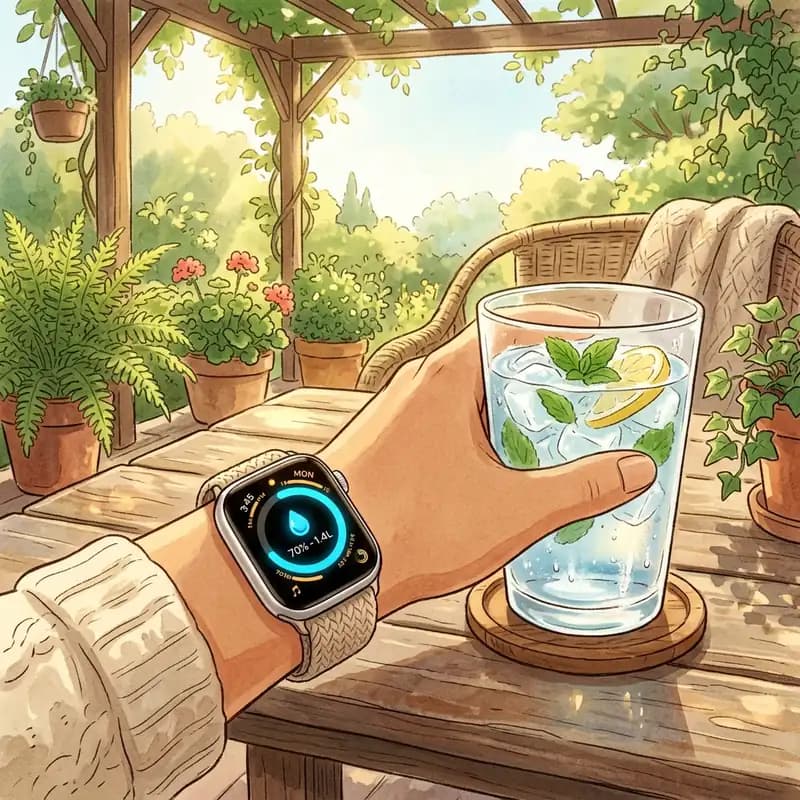
The Best Way to Use Apple Watch as a Water Reminder
How to turn Apple Watch into a real hydration coach: one-tap logging from your wrist, activity-based goals, and a watch face complication that shows your progress.
Ready when you are
Download DropWise for iPhone
Track hydration more easily with reminders, Apple Health sync, and a privacy-first flow.
By using DropWise, you agree to our Terms of Use and Privacy Policy.